

Handle more money than most people imagine. The U.S. government awarded over $1 trillion in grants during fiscal year 2023, which shows the massive scale and importance of this process. Grant managers spend almost 36% of their time monitoring administrative requirements.
The pandemic pushed digital transformation forward in research and grant administration. The reality of implementing grant management systems software doesn’t match vendor promises. Modern platforms promise better visibility through data-centric approaches. Yet organizations struggle with staff retention. Our survey revealed that all but one of these organizations cited attracting and keeping qualified grant management staff as their biggest challenge. Grant management systems for research organizations often promise detailed solutions with automated tracking and up-to-the-minute data analysis. The gap between vendor promises and ground performance remains substantial.
This piece explores what experts won’t tell you about modern grant management systems. You’ll discover everything from overlooked pre-award planning to AI limitations. We’ll give you a full picture of what you should know before your next technological decision.
The Real Story Behind Modern Grant Management Platforms
- The hidden challenges in grant lifecycle management
- Pre-award planning is often overlooked
- Post-award tracking is more complex than expected
- Why close-out is the most neglected phase
- AI and automation: what’s really happening
- Where AI helps and where it doesn’t
- The illusion of full automation
- How AI can mislead decision-making
- Data, dashboards, and the illusion of control
- Why more data doesn’t mean better decisions
- The problem with fragmented reporting
- How dashboards can hide deeper problems
- What Research organizations must know before choosing a system
- Grant management systems for Research organization: key considerations
- Vendor promises vs real-life performance
- Scalability and support: the long-term view
- Conclusion
- FAQs
1. The hidden challenges in grant lifecycle management
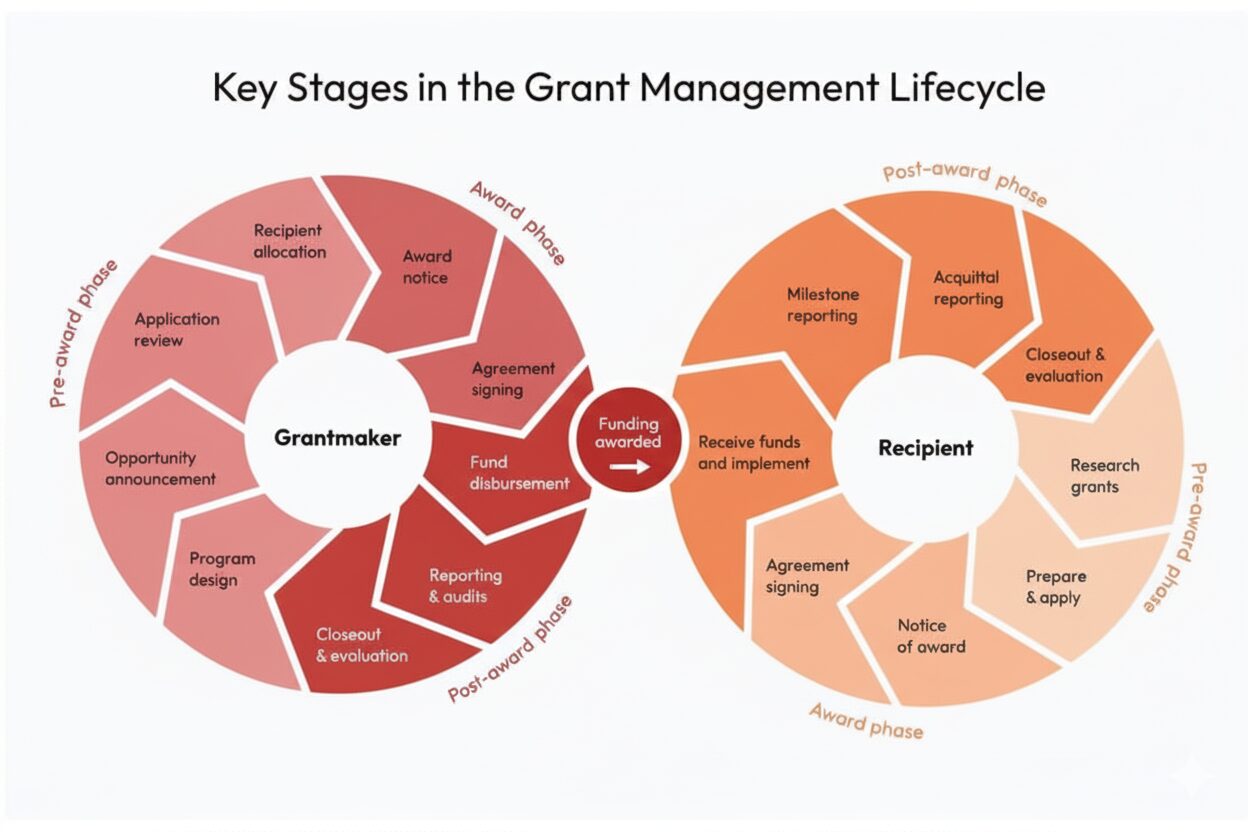
The grant lifecycle looks simple on paper, but it hides big challenges that many organizations find out too late. These hidden complexities often determine if a grant will succeed or fail.
2. Pre-award planning is often overlooked
Organizations often rush to apply for grants without proper preparation and set themselves up for trouble later. plays a vital role in securing and managing funding successfully, yet many underestimate its importance Pre-award grant management. A full picture should look at your operational capacity, staffing, past performance, and compliance tracking systems, yet many skip this vital step. Strategic collaborations with potential funders give advantages that organizations often miss. Projects can falter during review processes without proper pre-award planning, even when they’re strong.
3. Post-award tracking is more complex than expected
The real work starts after securing the funding. The post-award phase has lots of work throughout the award dates. Organizations must implement the grant, report on progress, and complete closeout requirements. Teams need to submit various programmatic and financial reports at specific times with complete accuracy. On top of that, research organizations don’t deal very well with complex compliance requirements, budget and cash flow management (especially with reimbursement-based grants), and tracking specific metrics that funders need. Organizations trying to manage multiple grants with manual methods or separate spreadsheets quickly run into bottlenecks, data problems, and compliance risks.
4. Why close-out is the most neglected phase
The closeout process may be the most critical phase, often gets overlooked. OMB Uniform Grants Guidance requires recipients to submit all financial, performance, and other reports within 90 days after the grant expires or terminates. Then the closeout process can take several months to settle financial concerns or questions. Recipients must handle any grant-funded property exactly as required and keep grant records for at least three years from the final expenditure report date. Organizations receiving risk being reported to the Federal Awardee Integrity Information System for noncompliance, which could hurt their future funding chances over $10 million in federal funds.
Modern grant management systems want to solve these challenges, but many organizations still don’t see how complex the grant lifecycle really is.
5. AI and automation: what’s really happening
The hype surrounding artificial intelligence in grant management often hides what it can and cannot do. My experience with dozens of organizations implementing these technologies has shown me the real gap between marketing promises and what happens on the ground.
6. Where AI helps and where it doesn’t
AI shines on repetitive, data-heavy tasks in grant management. It scans funding opportunities, matches them to your organization’s profile, and spots compliance issues early. Notwithstanding that, AI doesn’t deal very well with tasks that need contextual understanding. Grant narratives, building relationships with funders, and making strategic decisions still need human expertise. Many grant management systems tout AI capabilities for routine processes but quietly admit they fall short of complex grant design and stakeholder participation.
7. The illusion of full automation
Vendors often show grant management as a fully automated process, just push a button, and the system handles everything. The reality is that most grant management systems for research organizations need substantial human setup, maintenance, and regular oversight.
One myth needs busting: the “set it and forget it” approach. All but one of these sophisticated systems need:
- Regular updates to match changing funder requirements
- Human verification of automated compliance checks
- Manual intervention when unique situations arise
8. How AI can mislead decision-making
AI-powered analytics give useful insights, yet they can lead organizations down the wrong path. These systems make recommendations based on past data, which might reinforce old biases or miss changing priorities.
More importantly, dashboard-driven management creates a false sense of security. Executive directors and board members often feel comfortable with simplified metrics without understanding their limits. Note that when AI suggests funding opportunities or budget allocations, these recommendations come from algorithms that cannot understand your organization’s mission, values, and long-term vision.
The truth is that grant management works best with a careful balance of technological help and human judgment, a point few vendors highlight in their sales pitches.
9. Data, dashboards, and the illusion of control
Modern grant management systems collect so much information that many organizations feel overwhelmed by data without learning anything useful. This reality changes the way we review these platforms.
10. Why more data doesn’t mean better decisions
Today Grantmakers are drowning in information. Applications, proposals, progress reports, and impact metrics promise better decisions. The irony is that this abundance creates information overload, which makes it hard to find useful insights. Many organizations track “vanity metrics” rather than meaningful performance indicators. Collecting data without a clear purpose wastes money and resources.
11. The problem with fragmented reporting
Data silos waste the most time during the reporting season. Information gets stuck in different departments, which prevents an all-encompassing view of program results. A fragmented grants management process wastes both money and resources. Organizations that handle multiple grants face even bigger challenges from these disconnected systems.
12. How dashboards can hide deeper problems
Software vendors often promote dashboards as the answer to complexity. These interfaces can create small errors in grant tracking and become big problems, especially when you have different compliance standards and an illusion of control. Data needs extensive cleanup before analysis because formats aren’t standardized. Executive dashboards might show simple metrics but miss important limitations.
Research organizations looking for grant management systems should find solutions that bring all reporting data together, remove silos, and show what’s really happening instead of just pretty charts.
13. What Research organizations must know before choosing a system
Choosing the right grant management system can optimize your organization’s operations, but the wrong choice might drain your resources.
14. Grant management systems for Research organization: key considerations
Start by reviewing your organization’s specific needs, funding sources, and problems with your current processes grant volume Your current tech stack needs review because these systems must merge naturally with your financial and donor management tools. Before you commit, get demos from several vendors to test how well they fit into your workflow.
15. Vendor promises vs real-life performance
In stark comparison to this, what vendors promise often differs from reality. The setup needs a lot of configuration, maintenance, and human oversight. Many organizations find they need to run their system after implementation of additional consultants or staff. Other research organizations can help confirm or challenge what vendors say about their system’s performance.
16. Scalability and support: the long-term view
The real cost goes beyond the original price; you need to think over what your team will invest in setup, training, and support. Vendors with high client retention rates and satisfaction scores show reliability. Your GMS provider ended up being more than just a software vendor. They should be a mutually beneficial ally who offers various support channels and assigns a dedicated client success manager who knows your changing needs.
17. Conclusion
Grant management systems pack powerful features, but they also bring major challenges that vendors rarely mention. This piece reveals several hard truths about these systems that affect how well they work.
Your grant management success needs more than just software setup. Teams often overlook crucial elements like pre-award planning, post-award tracking, and closeout procedures. Many organizations learn too late that their system needs heavy human input, despite all promises of automation.
AI tools are a great way to get help with data processing and compliance checks. However, they can’t replace human judgment when building relationships, developing narratives, and making strategic decisions. Sales teams might suggest otherwise, but there’s no “set it and forget it” approach in grant management.
Flashy dashboards and data collection features can mask deeper problems. Organizations end up with pretty charts but still face issues with scattered reporting and system gaps. Research organizations should focus on gathering data that leads to better decisions instead of collecting information blindly.
Research organizations should evaluate their specific needs, current tech setup, and future goals carefully before picking up a system. The difference between what vendors promise and what happens in real life can be huge. That’s why you need to check their claims through peer feedback and detailed feedback.
The right system should work as a tool that improves your mission instead of making it complex. Technology changes faster now, but success depends on smart implementation, regular upkeep, and knowing what the system can and cannot do. These insights will help your organization make smart choices that support your grant management goals and avoid costly mistakes.
If you’re ready to move beyond vendor promises and see what effective grant management looks like in practice, explore how Fibi can work for your organization – schedule a personalized demo today.
18. FAQs
Q1. What are the key challenges in modern grant management?
The main challenges include overlooked pre-award planning, complex post-award tracking, and neglected closeout procedures. Organizations often struggle with compliance requirements, budget management, and accurate reporting throughout the grant lifecycle.
Q2. How effective is AI in grant management systems?
AI is helpful for repetitive tasks like scanning funding opportunities and flagging compliance issues. However, it struggles with nuanced tasks requiring contextual understanding, such as grant narratives and relationship building with funders. Full automation is often an illusion, as human intervention is still necessary.
Q3. Can grant management systems improve decision-making through data?
While these systems collect vast amounts of data, more information doesn’t necessarily lead to better decisions. Organizations often face information overload and focus on vanity metrics instead of actionable insights. Fragmented reporting and data silos can hinder a holistic view of program effectiveness.
Q4. What should research organizations consider when choosing a grant management system?
Research organizations should assess their specific needs, grant volume, and existing tech stack. It’s crucial to evaluate how the system integrates with current tools, request demos from multiple vendors, and consider long-term scalability and support. Verifying vendor claims through peer references is also important.
Q5. Is grant management a stressful process?
Yes, grant management can be stressful due to its complexity. Organizations often find the process overwhelming, with multiple moving parts including meeting deadlines, maintaining communication, and handling financial reporting. Effective systems and processes can help alleviate some of this stress, but the inherent challenges of grant management remain.



 Request a Demo